

By offering personalized products, brands create an emotional connection with their customers.
On digital platforms, personalization is common. The number of consumers has increased thanks to experiences that are aimed directly at them and that reflect their tastes and preferences.
Physical products, characterized by the rigidity of traditional manufacturing, are not so well received by users.
New technologies are changing this paradigm, opening up opportunities to avoid the traditional costs of manufacturing thousands of custom parts. Now you can connect the power of personalized digital experiences to physical products and ultimately develop deeper personal connections with consumers.
The Gillette company is at the forefront of this wave by launching the concept Razor Maker™ – a platform that serves as one of the first examples of end-use 3D printed parts.
using Formlabs Form 2 3D printers as a manufacturing engine, Razor Maker™ gives consumers the power to create and order custom 3D printed grips with the choice of 48 different designs, a variety of colors and the ability to add custom text.
“Our partnership with Formlabs and the power of 3D printers allow consumers to have a say in how their appliances should look. We are thrilled to partner with our neighbors in Boston to try out this revolutionary concept of customization,” said Donato Diez, global brand manager of Gillette and co-founder of Razor Maker™.
Learn how Razor Maker™ uses 3D printing to create unique products and how additive manufacturing can catalyze business transformation.
Unleash design freedom and the power of customization.
The Razor Maker™ concept offers design freedom from the designer’s desk to the final product and offers a glimpse into the future of mass-customized products.
“Combining best-in-class razor technology with the power and flexibility of 3D printing opens up a new world of design possibilities,” said Rob Johnson, design engineer and co-founder of Razor Maker™.
With 3D printing, complexity and variety are “free,” a 3D printer requires no more time, energy, or material to produce a complex shape than a simple shape, and zero tools means printing a variety of designs that require no additional manufacturing costs.
Designers drew inspiration from geometries found in nature, architecture and technology to create complex shapes that would be difficult or impossible to achieve through traditional manufacturing.
“It allows us to think about form in a way that has never been possible before,” said Rory McGarry, head of industrial design at Razor Maker™. “In the traditional sense, we might only design one or two devices a year, whereas now we can have an idea, 3D it, print it, look at it, adapt it and say it’s done.”
Finally, the lack of varied design limits the ability to offer consumers freedom of choice. In a market saturated with mass-produced goods, Razor Maker™ aims to give consumers the ability to produce razors entirely of their own.
“We know that today’s consumers are looking for brands that innovate in ways that allow them to express themselves – and that’s exactly what this pilot does,” said Evan Smith, product manager of Razor Maker™.
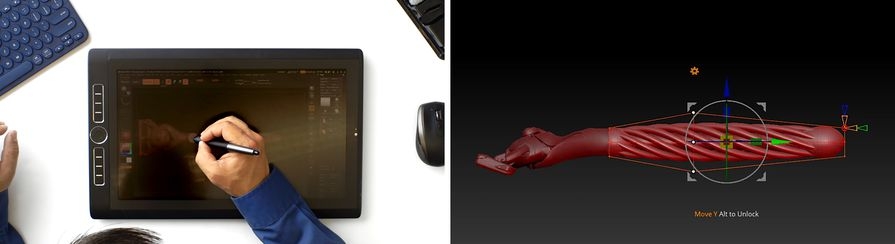
Custom manufacturing workflow
Pursuing such a high level of customization for the Razor Maker™ led the team to completely rethink their approach to manufacturing.
The initial stages of the process are completely digital: the consumer customizes a unique handle through the website Razor Maker™and the resulting design is transformed into a 3D file. Multiple design files are sent to a 3D printer to be printed simultaneously in a single batch. Each handle is then washed, post-processed, coated and assembled before being shipped directly to the consumer’s home.
In the past, Gilette only used 3D technology to produce prototypes, but advances in materials and hardware have made 3D technology a viable option for producing final components. Ease of customization is an inherent advantage of 3D printing. The technology eliminates the need for tooling, requires no upfront investment in molds and eliminates the exponential costs associated with producing a variety of complex designs.
Plus, scaling up custom production can be as easy as adding more printers. Gillette is also experimenting with automating 3D printing manufacturing processes, partnering with Formlabs as one of the first testers of the Form Cell, a technology demonstration that explores the future of 3D printing in manufacturing environments.
More and more manufacturers are integrating technologies such as stereolithography (SLA) 3D printing into their production flows.
The Razor Maker™ concept has revolutionized the way Gillette approaches product design. By enabling the creation, printing, and testing of a new design within just a day, this innovation allows fresh handles to quickly become available for purchase on their site—something previously unimaginable. However, transforming manufacturing goes beyond simply adopting cutting-edge technology. It’s about rethinking the entire ecosystem. Companies like Gillette are leveraging 3D printing not just as a tool, but as a catalyst for exploring innovative business models. These models reimagine operations at every stage of the product lifecycle, starting from design and extending all the way to manufacturing. For Gillette, Razor Maker™ marks a milestone in their journey toward personalization. As stated by Diez, the initiative represents a powerful fusion of next-generation technologies and modern business strategies, all aimed at delivering products as distinctive as the consumers themselves.
latest posts published

What can 3D scanning do for reverse engineering?

Ultimaker opens new possibilities for industrial printing!

Fields of applicability of 3D technology

3D scanning improves inspection and maintenance of race cars

ABS filaments for 3D printing

PET filaments for the 3D printer

How to optimize mold inspection for auto parts

The best large format 3D printers. The buyer’s guide

How architectural models are created using additive manufacturing
