
The good news continues to arrive for dental technicians, those at Formlabs are continuously developing the segment of special resins for orthodontic applications.
The other days Formlabs released the update to the PreForm slicer which allows faster printing with Formlabs Dental Model resin.
With the new upgrade of the PreForm slicer, you can print with Dental Model resin with a layer height of 140 microns with amazing precision and speed, so the time to make an orthodental model is much less, but its quality and strength are not affected.
Let’s see exactly what time difference you can save now, when Resin for dental models it can be printed with 140 micron thick layers.
|
|
100 microns
|
140 microns
|
|
1 model
|
1 hour and 15 minutes
|
37 minutes
|
|
7 models
|
3 hours 45 minutes
|
2 hours 36 minutes
|
Don’t forget it for a finished surface and it is recommended to print with Fine 50 micronsbut for orthodontic models used for thermoforming can be printed with 140 micronswhere the model characteristics are again carefully preserved printing time is significantly reduced.
Other new features delivered with PreForm 2.20
Z compression correction: Compressing the first few layers can affect the height of the final part, and the new feature allows manual adjustment of the layers, ensuring much greater accuracy of the part on the Z axis. This feature is effective when printing directly onto the print surface.
Smaller touchpoints: To maintain the fine details of the model, PreForm will automatically create smaller support points when the minima are small and difficult to reach.
Initial layer merging: «Early Layer Merge» is a feature introduced in PreForm version 2.18 that helps increase the adhesion of the part to the print bed when it is not printed with a base support (shelf). The new PreForm version allows partial control of the characteristic parameters of this option.
Greater accuracy in print time estimates: The new version of the PreForm slicer features an improvement in estimating the required printing time, taking into account more precisely the time spent in detecting and distributing resins, so the time calculated and displayed in the slicer for printing the model will be closer to the actual time needed for printing.
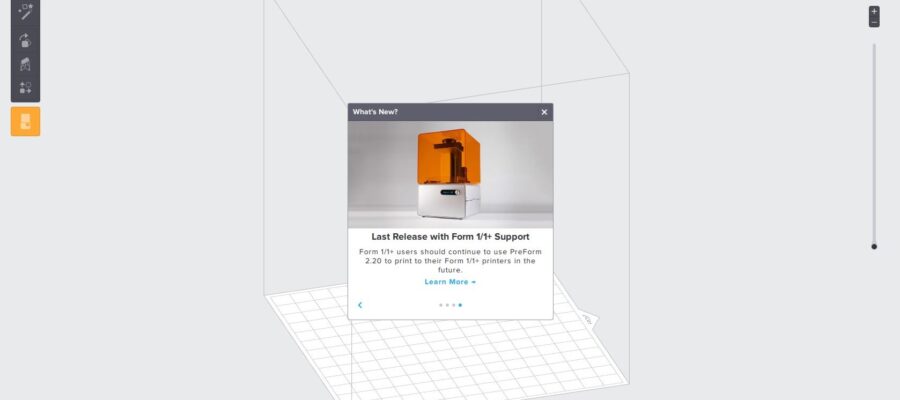
PreForm version 2.20 is the latest version compatible with Formlabs Form1 and Form1+ 3D printers.
Conclusion
The continuing news regarding Formlabs’ commitment to developing specialized resins and software updates confirms a focus on accelerating the digital transformation within the dental and orthodontic industries. The announcement of the update to the PreForm slicer is particularly beneficial for dental technicians as it enables faster printing when utilizing the Formlabs Dental Model resin. This improvement directly translates into increased efficiency, reduced turnaround times, and ultimately, greater throughput for dental laboratories. By optimizing both the material (specialized resins for orthodontic applications) and the preparation software (PreForm), Formlabs is actively working to make high-precision 3D printing a more productive and indispensable tool in modern digital dentistry.
latest posts published

What can 3D scanning do for reverse engineering?

Ultimaker opens new possibilities for industrial printing!

Fields of applicability of 3D technology

3D scanning improves inspection and maintenance of race cars

ABS filaments for 3D printing

PET filaments for the 3D printer

How to optimize mold inspection for auto parts

The best large format 3D printers. The buyer’s guide

How architectural models are created using additive manufacturing
